Example FRCS Plast questions
Basic Science: FRCS(Plast) example questions
Our basic science coverage runs across the whole FRCS(Plast) curriculum, from wound healing and graft biology through flap physiology, to microsurgery and biomaterials, with illustrated questions and referenced explanations throughout.
Wound healing & scarring
Skin structure & histology
Graft biology
Flap physiology & angiosomes
Microsurgery
Embryology & development
Biomaterials & implants
Back to Overview

Acanthosis means epidermal hyperplasia - thickening of the stratum spinosum, usually with elongated rete ridges. It is a non-specific reactive change, so the diagnosis rests on the pattern of atypia, not the acanthosis itself.
Full-thickness keratinocyte atypia with an intact basement membrane and no dermal invasion defines squamous cell carcinoma in situ (Bowen disease). Extension down follicular infundibula is characteristic and explains why superficial destructive treatments sometimes fail.
Other answers:
Hypertrophic actinic keratosis - atypia confined to the lower third, alternating ortho- and parakeratosis sparing the adnexal ostia.
Verruca vulgaris - papillomatosis (increased depth of corrugations at the dermoepidermal junction), koilocytes, tiers of parakeratosis over papillary tips.
Superficial BCC - buds of basaloid cells with peripheral palisading (nuclei oriented perpendicular to the stroma) and retraction clefting.
Extramammary Paget disease - pagetoid spread: large pale cells scattered singly through the epidermis, CK7 and PAS positive.
Lower-leg Bowen disease heals poorly. BAD guidance supports 5-fluorouracil, cryotherapy, curettage, imiquimod or photodynamic therapy, reserving excision for diagnostic uncertainty, treatment failure or suspected invasion.
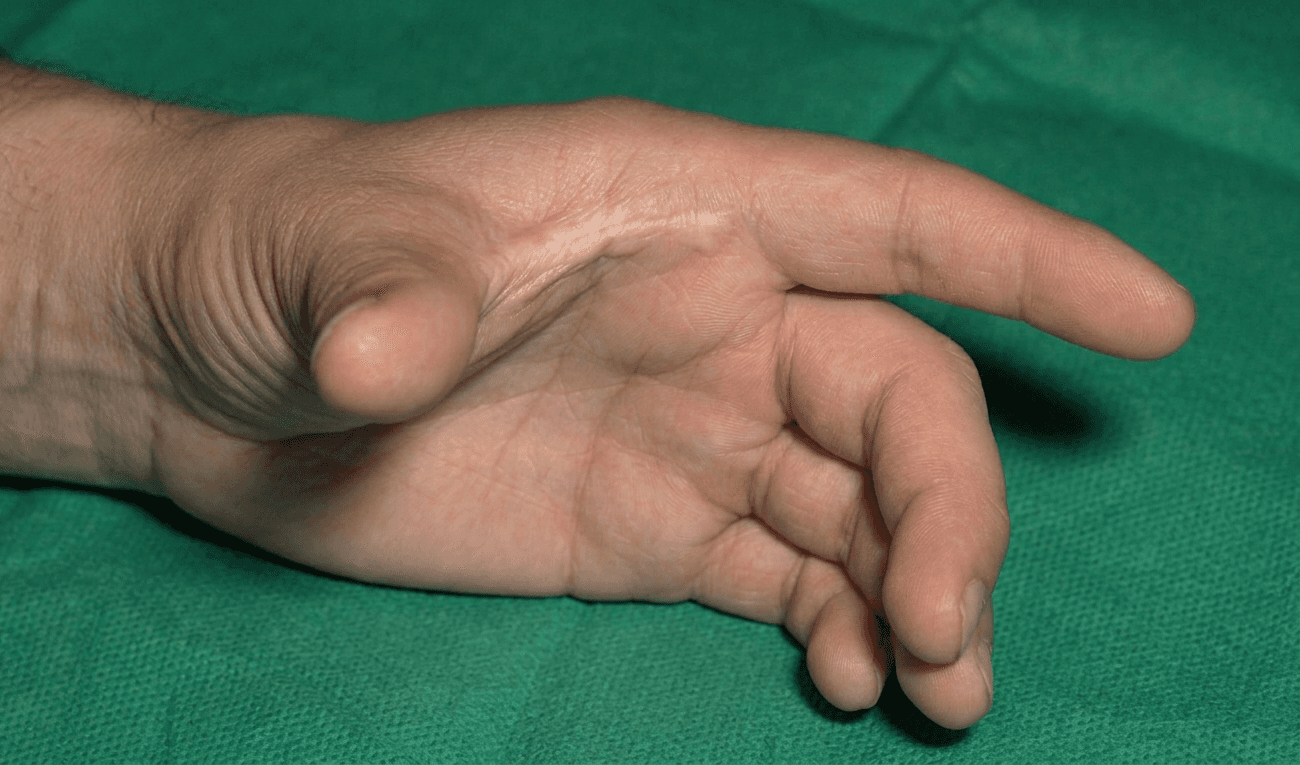
The five-flap plasty, "jumping-man" flap, combines two opposing Z-plasties with a central V-Y advancement.
It is the technique of choice here:
The paired Z-plasties break up and lengthen the band using supple lateral skin, whilst the central V-Y advances the lax proximal palmar skin directly into the apex of the web. F
Flaps marked A–E transpose to B-A-C-E-D.
Other answers:
Four-flap plasty - gives the greatest theoretical deepening for a given central limb (Fraulin & Thomson) but requires greater transverse laxity for flap transposition and has no central advancement, less suited when dorsal laxity is limited.
Release and grafting is reserved for severe, broad contractures where local tissue is insufficient.
A single Z-plasty - lengthens (~75% for 60° limbs) but cannot adequately deepen a web.
V-Y advancement alone - does not address the band.

frcs(plast) part 1 question bank
Better questions.
Better preparation.
Give yourself the months that matter. Start revising with a question bank built for the exam.