Example FRCS Plast questions
Burns: FRCS(Plast) example questions
Our burns coverage spans the whole JCST curriculum - from referral criteria and resuscitation through to early excision, late contracture release and paediatric burns - with illustrated questions and referenced explanations throughout.
Assessment & referral
Burns resuscitation
Early excision & grafting
Burn scar reconstruction
Burns complications
Paediatric burns
Back to Overview
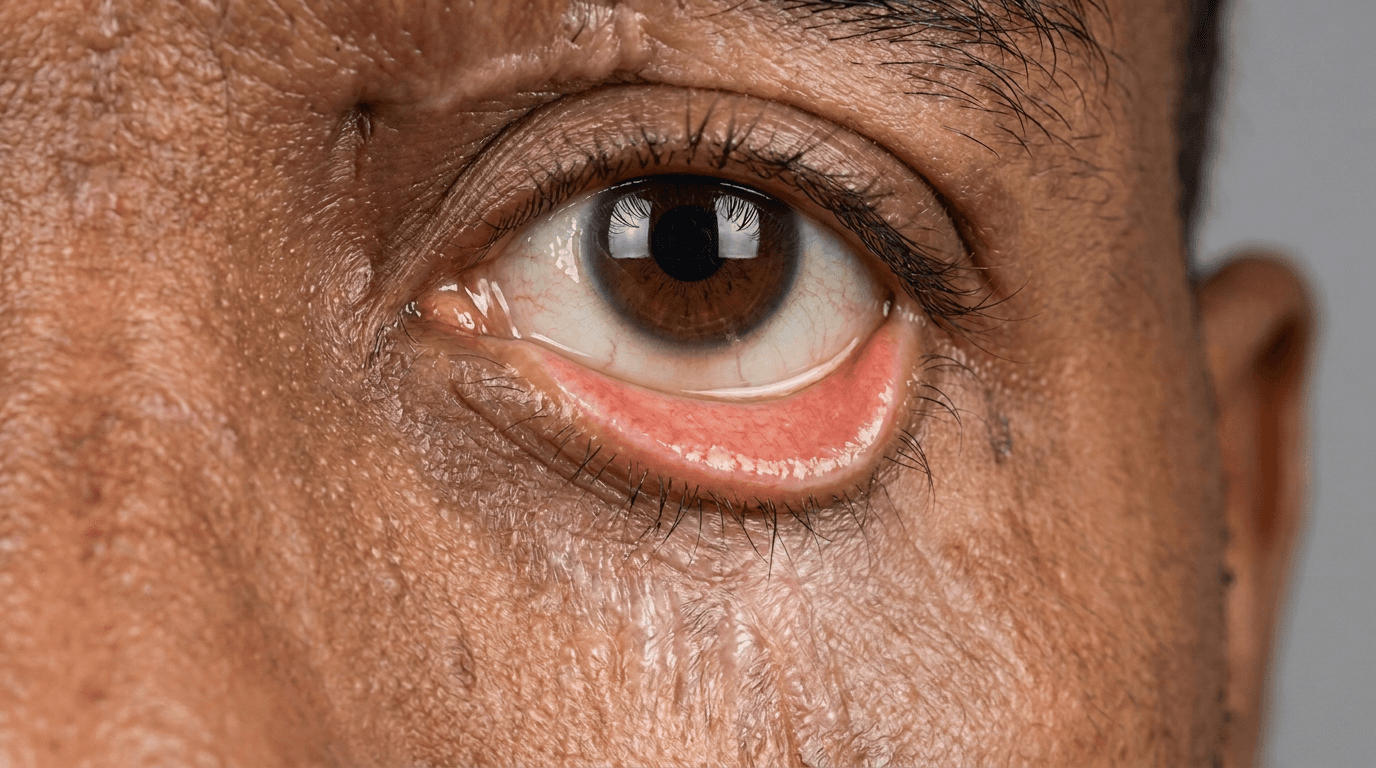
Ectropion is classified by what has failed:
Involutional - horizontal laxity of the tarsoligamentous sling; ageing. Corrected by shortening (lateral tarsal strip).
Cicatricial - vertically short anterior lamella; burns, trauma, actinic damage, over-resection at blepharoplasty. Corrected by releasing and replacing skin.
Paralytic - loss of orbicularis tone; facial nerve palsy. Corrected by static support (tarsal strip, sling, tarsorrhaphy).
Mechanical - the lid is dragged down by weight; tumour, oedema. Corrected by removing the cause.
This patient has both cicatricial and involutional elements - the lid is tethered and cannot be lifted above the pupil, and it distracts 9 mm with a delayed snap-back. Correcting only one will recur.
Release the scar through a subciliary incision until the lid lifts freely, resurface with an oversized full-thickness graft (upper lid, pre- or post-auricular, supraclavicular), then tighten with a lateral tarsal strip. Support the lid with a Frost suture and bolster.
Other answers:
A - tightens but leaves the scar.
B - Split-thickness grafts contract, which is what caused the initial problem.
C - adjusts the midface without adding skin.
E - suits an immature, untethered scar, not established keratopathy.

Laser Doppler imaging (LDI) measures dermal microvascular blood flow, which correlates with burn depth and, more usefully, healing potential.
NICE recommends LDI as an adjunct to clinical assessment in burns of indeterminate depth. Accuracy is highest between days 2 and 5 post-burn, which is why very early scanning is unreliable.
Low flux (<220 PU, blue) predicts healing beyond 21 days, indicating deep dermal or full-thickness injury. Wounds taking longer than 21 days to heal carry a high risk of hypertrophic scarring, so the standard of care is early tangential excision and grafting, particularly in functionally important areas such as the dorsum of the hand.
Other answers:
Continuing dressings or repeating the scan delays definitive treatment.
Biobrane is suited to confirmed superficial partial-thickness burns.
Biopsy is invasive, samples only one point, and adds nothing once LDI has predicted non-healing.
frcs(plast) part 1 question bank
Better questions.
Better preparation.
Give yourself the months that matter. Start revising with a question bank built for the exam.