Example FRCS Plast questions
Upper Limb: FRCS(Plast) example questions
Our coverage spans the whole JCST hand and upper limb curriculum, from zone II flexor tendon repair and scaphoid non-union through to brachial plexus injury and congenital hand differences, with illustrated questions and referenced explanations throughout.
Soft tissue & Dupuytren's
Hand & wrist fractures
Arthritis of the hand
Tendon injury & transfers
Nerve & brachial plexus
Congenital hand & tumours
Back to Overview

Paediatric trigger thumb is acquired, not congenital. Prospective screening of over 1,100 newborns found none at birth, so the term "congenital trigger thumb" is a misnomer. Children present with a fixed IPJ flexion deformity rather than true triggering, with Notta's nodule often palpable in the FPL at the A1 pulley.
Observation is the correct initial approach:
around 30% resolve within a year and over 60% by four years, with further resolution beyond that.
Here, observation has already been given two years and the deformity is now fixed, so spontaneous correction is unlikely and release is indicated.
Correction of the IPJ contracture is usually achieved by releasing the A1 pulley alone.
Release is open and under general anaesthesia in children - the radial digital nerve crosses obliquely and superficially at the thumb MCPJ, making percutaneous release unsafe at this age.
Other answers:
Steroid injection has little paediatric evidence and would require an anaesthetic regardless.
Splinting will not correct an established contracture.
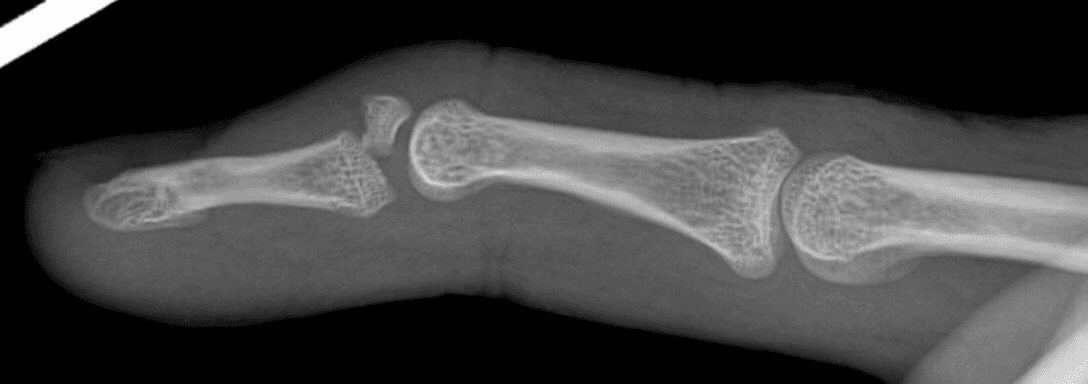
This is a bony mallet injury - avulsion of the terminal extensor tendon with a dorsal lip fragment of the distal phalanx, caused by forced flexion of an extended DIPJ.
The discriminator in this question is volar subluxation of the distal phalanx. The majority of closed bony mallet injuries - even with substantial articular involvement, heal satisfactorily with continuous DIPJ extension splinting for 6–8 weeks, and systematic reviews demonstrate no clear superiority of surgery over splinting in non-subluxated injuries. Subluxation, however, is the one widely-accepted surgical indication: without reduction the joint remains incongruent and develops post-traumatic arthritis.
The Ishiguro extension block technique is the standard approach: a K-wire is placed obliquely through the head of the middle phalanx dorsal to the avulsed fragment to act as a buttress, the DIPJ is then extended to lever the fragment into reduction, and a second trans-articular K-wire maintains the DIPJ in extension. It is closed, low-morbidity and reliably restores joint congruity.
Other answers:
Splinting alone (A) fails when subluxation is present.
Hook-plate ORIF (C) is technically demanding given the small fragment.
Trans-articular K-wiring alone (D) addresses joint position but not the displaced fragment.
Arthrodesis (E) is a salvage option.
NB - some units (in line with BSSH practice) first attempt closed reduction, and, if the joint remains subluxed, stabilise with a single trans-articular K-wire alone, reserving extension block wiring for fragments too small or comminuted to reduce indirectly. Where the fragment reduces anatomically with joint reduction, this is an accepted alternative. In this vignette, however, the persistently subluxated joint with a displaced dorsal fragment is best served by the extension block technique, which controls both the fragment and the joint, and remains the most widely examined answer.
frcs(plast) part 1 question bank
Better questions.
Better preparation.
Give yourself the months that matter. Start revising with a question bank built for the exam.